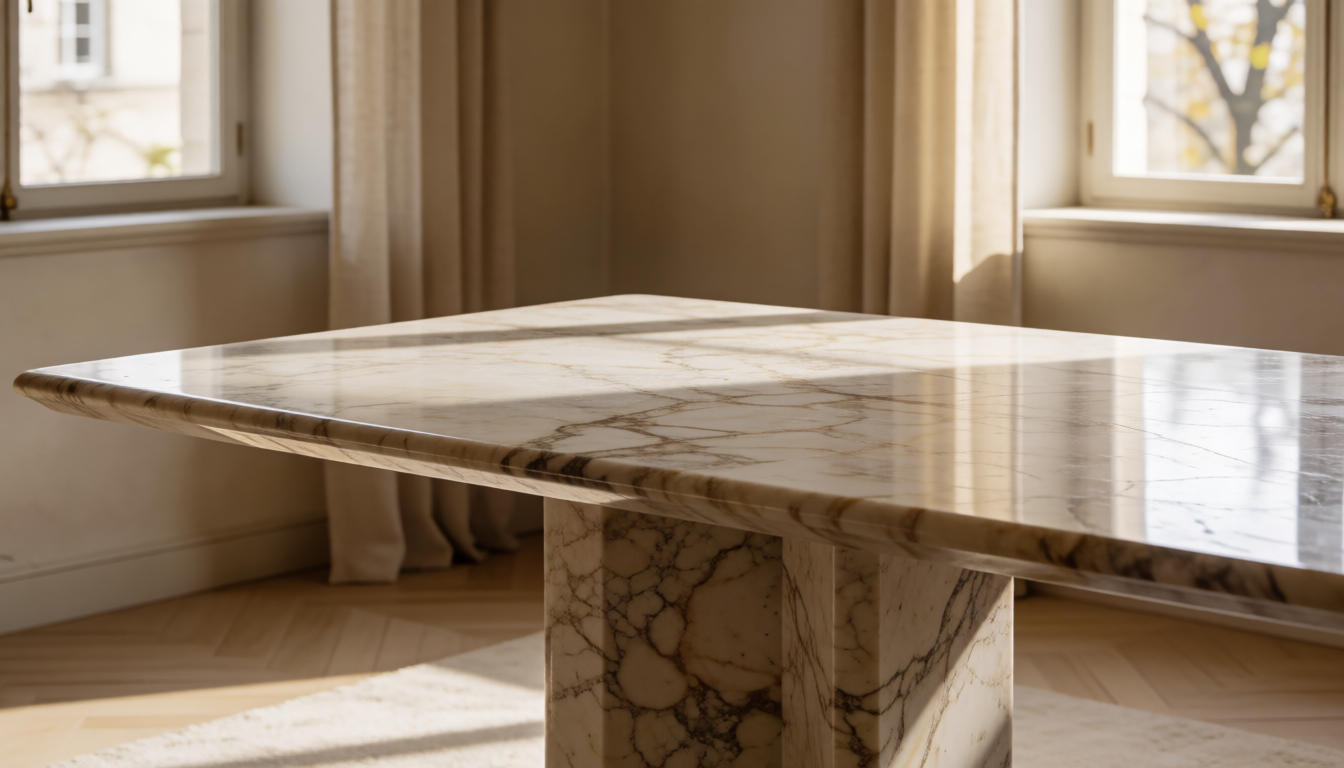
Choosing between a round marble dining table and a rectangular marble table isn’t just about aesthetics; it is a critical sourcing decision that impacts your warehouse space, shipping logistics, and final assembly for customers. As a B2B buyer or importer looking to stock these items for your Shopify store or white-label brand, you need to understand how the marble table shape dictates cost, lead time, and installation requirements. At Gladystone, we manufacture both styles extensively, but the production realities differ significantly between them. This guide breaks down the practical differences so you can select the right SKU mix for your market.
Space Dynamics and Shipping Efficiency
The most immediate factor in your decision is how the product occupies space on a warehouse floor and inside a shipping container. A rectangular marble table typically measures 120cm to 180cm in length, 80cm to 90cm in width, and stands about 75cm high. These dimensions allow for efficient stacking or nesting if your tables feature drop-leaf mechanisms. Even solid slab tables can be packed tightly side-by-side because their corners align with standard pallet patterns.
Conversely, a round marble dining table presents unique shipping challenges due to its diameter. Common diameters range from 90cm to 150cm. A 140cm round table cannot be shipped flat in a standard container like a rectangular slab can; it requires specific crating to prevent the stone edge from breaking against other goods. This means higher crating costs and potentially lower container utilization rates compared to rectangular units.
From a warehouse perspective, storing round tables requires more floor space per unit because they cannot be easily pushed together in rows. If your storage facility is tight, the round marble dining table will increase your overhead costs significantly unless you have dedicated vertical racking or ample open floor space. For dropshippers with limited backend inventory, the rectangular option offers a safer bet for logistics efficiency.
Assembly Complexity and Customer Experience
Consider the unboxing experience of your end customer. A standard rectangular marble table usually arrives fully assembled if ordered from our factory direct. The top is one continuous slab, and the base (often steel or solid wood) is bolted on during final quality control at Gladystone. The customer simply lifts it out of the box and places it in their room. This reduces returns due to “assembly error” complaints.
The round marble dining table often comes with a two-part top design to facilitate shipping: a central core surrounded by a rim, or a segmented slab that must be joined on-site. While we can ship solid round slabs if the diameter allows, the risk of transit damage increases as the curvature lengthens. If your customers assemble the piece themselves, you must provide clear diagrams showing how to join the segments without damaging the polished surface. Misalignment during assembly is a common cause of returns in this category.
Furthermore, the base height and stability differ. Rectangular bases often utilize an H-frame or pedestal design that supports long spans easily. Round tables rely on a central pedestal or four curved legs. The latter can wobble if the floor isn’t perfectly level, leading to customer dissatisfaction. When sourcing from us, we ensure all round table bases are laser-levelling tested, but you must account for potential warranty claims related to uneven flooring when marketing these specific products.
Cost Structure and MOQ Considerations
Pricing structures vary heavily based on slab size and shape complexity. A rectangular marble table is often priced per square foot or meter of slab area. We typically source slabs ranging from 120cm x 300cm for smaller tables up to massive 300cm x 400cm slabs for executive dining sets. The cost is linear; a larger table simply uses more stone, but the fabrication process remains relatively straightforward. Expect rough pricing between $800 and $1,500 USD for a standard 6-seater rectangular unit depending on the marble grade (Calacatta, Statuario, or Carrara).
A round marble dining table commands a premium due to cutting waste. Cutting a circle from a rectangular slab generates significant off-cuts that cannot be easily repurposed into smaller rectangular tops without compromising structural integrity. Consequently, the material cost per square foot is higher for round shapes. Additionally, the fabrication time is longer as the edge must be polished into a perfect curve rather than a straight line with mitred corners.
Minimum Order Quantities (MOQ) also differ. For standard rectangular marble table designs, we often accept MOQs as low as 2–4 pieces for specific slab patterns if you are stocking for your own brand. However, for custom round tables with specific diameter requirements or unique pedestal finishes, our MOQ might start at 10 units to justify the setup costs in our workshop. Always ask us about the lead time for “stock” shapes versus custom cuts, as a rush order for a rare slab pattern could delay delivery by 15–30 days.
Design Versatility and Market Application
Finally, consider where your customers will place these pieces. A rectangular marble table is the workhorse of American and European dining rooms. It works well against walls, in galley kitchens, and in large open-plan living areas where seating arrangements can be flexible. The shape accommodates high-back chairs at the heads and standard chairs on the sides.
The round marble dining table, however, excels in social settings without corners to hit elbows or knees. It is ideal for smaller rooms with awkward layouts, such as penthouse apartments or European country houses where space is premium. If you are targeting a niche market of interior designers who specialize in compact luxury homes, the round shape offers a distinct selling point that justifies a higher retail margin.
When building your product line, balance these options based on your target demographic. Younger buyers renting in cities may prefer the space-saving efficiency of round tables or smaller rectangular drop-leaf versions. Older demographics or those buying for primary residences often gravitate toward the classic rectangular marble table for formal dining. By offering a curated selection that includes both shapes, you maximize your catalog appeal while managing inventory risk effectively.