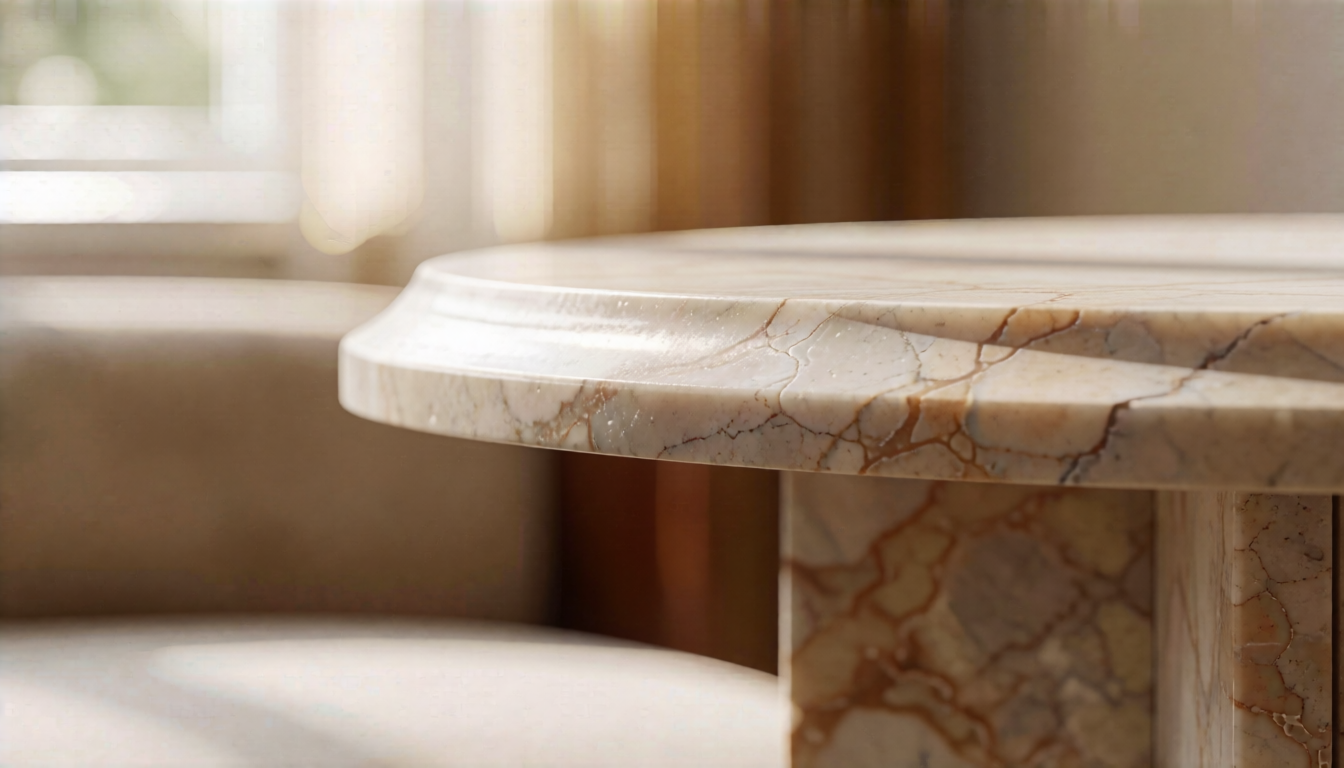
Buying stone furniture from China requires moving beyond generic listings to understand the specific mechanics of slab fabrication and logistics. As an importer or brand looking for a marble side table, you are dealing with a material that is heavy, fragile during transit, and highly variable in appearance. The market in 2026 demands transparency on thickness, veining consistency, and lead times. This guide breaks down exactly what to inspect when sourcing a natural stone side table from a factory like Gladystone, covering dimensions, pricing structures, and the critical steps to ensure your stock arrives intact.
Understanding Slab Thickness and Structural Integrity
The most common point of failure in imported stone furniture is insufficient thickness relative to the design style. For a standard stone side table, manufacturers typically offer two primary slab thicknesses: 1.8cm and 2.0cm. While 1.8cm is standard for modern, minimalist designs, it requires specific edge profiling (like straight or beveled edges) to look premium without being weak. If you plan on offering a carved or curved design, you must request a minimum of 2.5cm thickness.
Weight is another critical factor for your logistics team. A typical 60x60cm square table top made of Carrara marble weighs roughly 18-22kg depending on density. When paired with a steel or solid wood base, the total package weight can exceed 40kg per unit. You need to know this before calculating shipping costs or hiring ground freight. Always ask the supplier for the net weight vs. gross weight including packaging. A heavy marble side table shipped in standard export wooden crates without internal bracing often arrives with cracked tops. Request that factories use honeycomb cardboard inserts between slabs during packing to prevent shifting inside the crate.
Veining Consistency and Color Matching Risks
One of the biggest complaints from US/EU retailers is receiving tables where the veining pattern does not match their marketing photos. This happens because natural stone is not a repeatable print; it is extracted from quarries in Italy, China, or Brazil with unique geological histories. When sourcing a natural stone side table, never expect an exact replica of a photo unless the supplier can pull from the same slab batch.
For 2026 buyers, the trend is shifting toward “living room” consistency rather than perfect match. If you are building a collection of matching sets, ask for samples from the same quarry block or even the same slab. A rough rule of thumb: if two tables look slightly different under showroom lighting but share the same base color and vein style, they will pass in 90% of residential applications. However, if you are selling to high-end interior designers who demand exact matches, you must build a larger MOQ to secure enough slabs from one single extraction.
Base Design Options: Steel, Wood, and Stone-on-Stone
The base of the table significantly impacts cost and shipping efficiency. Steel bases are the most economical and durable option for a marble side table. They allow for complex geometric shapes (hexagons, circles) without adding excessive weight. A standard powder-coated steel base adds roughly $30-$50 to the unit cost depending on complexity.
Solid wood bases offer warmth but increase shipping volume due to the need for more protective packaging against humidity changes. Stone-on-stone legs exist but are rare and heavy; they usually require a 3cm+ slab thickness for stability. If you choose a steel base with a marble top, ensure the connection points are reinforced. A common failure mode is the metal leg bending over time if the stone is not perfectly level during installation. Ask your supplier to pre-drill mounting holes or provide specific drilling templates to ensure your assembly team can work quickly without errors.
Pricing Structures and MOQ Flexibility for Dropshippers
Pricing for stone furniture varies wildly based on slab origin and finish quality. A rough price range for a basic 60x60cm stone side table with a simple steel base is $85-$120 FOB (Free On Board) from China, excluding shipping. Higher-end varieties like Calacatta Gold or Statuario can push the unit cost to $140-$190 depending on the rarity of the white background and gold veining.
For dropshippers and smaller brands, Minimum Order Quantities (MOQ) are the biggest hurdle. Many factories demand 50-100 units per color/design combination. This ties up significant capital if your sales velocity is slow. Gladystone and similar forward-thinking manufacturers often offer flexible MOQs for new products, such as 10-20 pieces per style, provided you pay a higher price premium or commit to a longer contract term. Always negotiate the payment terms; 30% deposit and 70% against shipping documents is standard, but securing a credit line can help manage cash flow during long lead times.
Lead Times and Production Scheduling in 2026
Lead times for natural stone have stabilized but remain sensitive to raw material availability. Standard production time for a simple marble side table order of 50 units is roughly 18-22 days after payment. This includes cutting, polishing, edge profiling, and base assembly. However, if you are ordering custom sizes or specific rare stones, expect the timeline to extend to 30-40 days.
Shipping time adds another variable. Ocean freight from Ningbo or Shanghai to Los Angeles or Rotterdam typically takes 25-35 days. Air freight is faster (5-7 days) but costs 3-5 times more per kilogram. For a heavy item like stone, air freight is rarely cost-effective unless the order is very urgent and small. Plan your inventory cycles around the total lead time of 45-60 days. If you miss the production window due to delayed payment or design changes, the factory may move your order to the back of the queue, adding another month.
Quality Control: What to Check Before Shipment
Do not rely solely on the factory’s QC report. As an importer, you must define your own acceptance criteria before the container leaves the port. Key checks include:
1. Cracks and Chips: Inspect all edges for hairline cracks. These are common in transportation. Reject any unit with a crack longer than 2cm or a chip at the corner.
2. Color Variation: Compare random samples against your approved standard. Note that lighting conditions change how veining appears. Ensure the buyer agreement allows for natural variation.
3. Base Finish: Check for rust spots on steel bases, especially if they were not properly sealed before packing. Wood bases should be free of splinters and varnish drips.
4. Packaging Integrity: Open a random crate upon arrival to see how the internal bracing held up. If one unit was damaged by movement inside the crate, assume the others might have suffered similarly.
FAQ
What is the minimum order quantity (MOQ) for a custom marble side table design?
For standard designs in stock, MOQs can be as low as 10-20 units per color. For completely custom dimensions or unique base shapes, factories typically require 50-100 units to justify tooling and setup costs. Some manufacturers like Gladystone offer flexible tiers where you pay a premium for lower quantities, allowing new brands to test the market without over-committing capital.
How long does it take to produce and ship an order of stone furniture?
The total lead time from deposit payment to delivery at your warehouse is typically 50-60 days. This includes 18-22 days for production (cutting, polishing, assembly), 7-10 days for inland transport to the port, and 25-35 days for ocean freight. Air freight can reduce shipping time to 5-7 days but will significantly increase the unit cost due to weight restrictions.
Why does the price of a marble side table vary so much between suppliers?
Price differences usually stem from three factors: slab origin (Italian slabs cost more than Chinese domestic quarries), finish quality (polished vs. honed, and edge profiling complexity), and base material (solid wood is heavier and costlier than powder-coated steel). Additionally, suppliers with lower overhead or less rigorous QC may offer lower prices but higher risk of defects like hidden cracks or inconsistent coloring.
Can I mix different stone colors in one shipping container?
Yes, but it requires careful planning to minimize damage. Mixing colors is often possible if the slabs are packed separately with adequate buffering material between them. However, different stone types may have different density and fragility levels, so ensure your packing crate design accommodates the heaviest item first or uses specific dividers to prevent shifting during the voyage.
Quick Comparison
| Feature | Standard Steel Base Table | Solid Wood Base Table | Stone-on-Stone Leg Table |
|---|---|---|---|
| Typical Unit Cost | $85 – $120 | $130 – $170 | $160 – $220 |
| Net Weight (approx) | 25 – 35 kg | 35 – 45 kg | 50 – 60 kg |
| Production Lead Time | 18 – 22 days | 20 – 25 days | 25 – 30 days |
| Best For | High-volume dropshipping | Luxury residential lines | Architectural/designer projects |