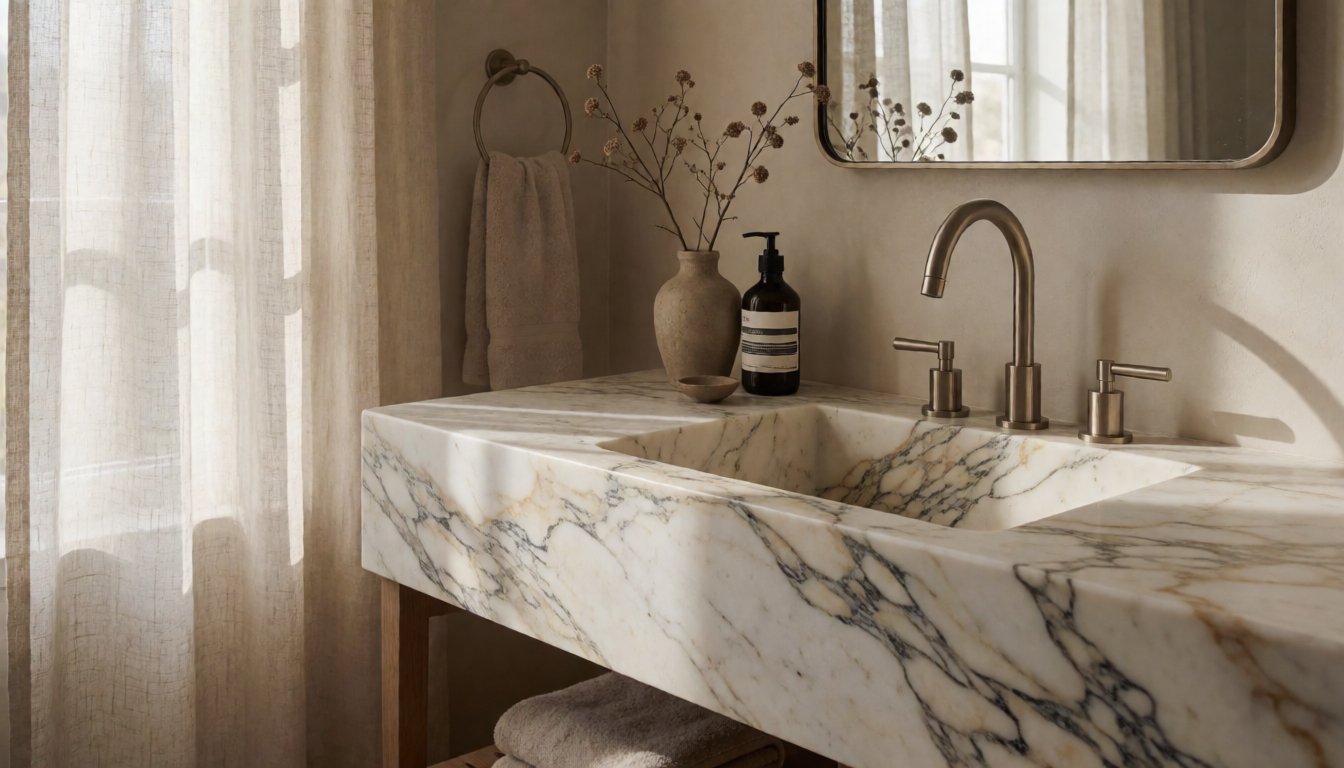
Reclaimed marble sinks are bathroom basins crafted from stone offcuts, remnants, and decommissioned building materials that would otherwise go to landfill. They reduce the carbon footprint of a stone sink by an estimated 35–40% compared to virgin marble, while delivering identical durability and aesthetics.
What Is a Reclaimed Marble Sink?
A reclaimed marble sink starts its life as a fabrication offcut—the unused portion of a slab after a countertop or tile is cut. Rather than discarding these pieces, specialist fabricators hand-select offcuts with sufficient size and visual appeal to be shaped into basins. The result is a sink with the same structural integrity as any virgin-stone product, often with more character due to unique veining patterns that large-scale production cannot replicate.
Why Are Reclaimed Marble Sinks Trending in 2026?
Three converging factors are driving specification decisions this year:
- Sustainability mandates: Commercial hospitality projects and high-end residential developments increasingly require documented environmental impact reductions. Reclaimed stone provides a measurable win.
- Provenance narrative: End clients respond to the story behind the material. A sink with a known origin—”Carrara offcut, sourced from a excess slab at a Milan fabrication house”—commands a premium over anonymous mass-produced alternatives.
- LEED and BREEAM credits: Specifying reclaimed materials contributes to certification points under the Materials and Resources category.
How Durable Are Reclaimed Marble Sinks Compared to New Stone?
Durability is identical. Marble does not degrade from sitting in a fabrication yard or warehouse. The critical factor is the same for reclaimed and virgin stone: proper sealing. A honed marble sink should be resealed every 12–18 months; a polished sink every 18–24 months. With correct maintenance, both last decades.
River Stone Basins: The Organic Alternative
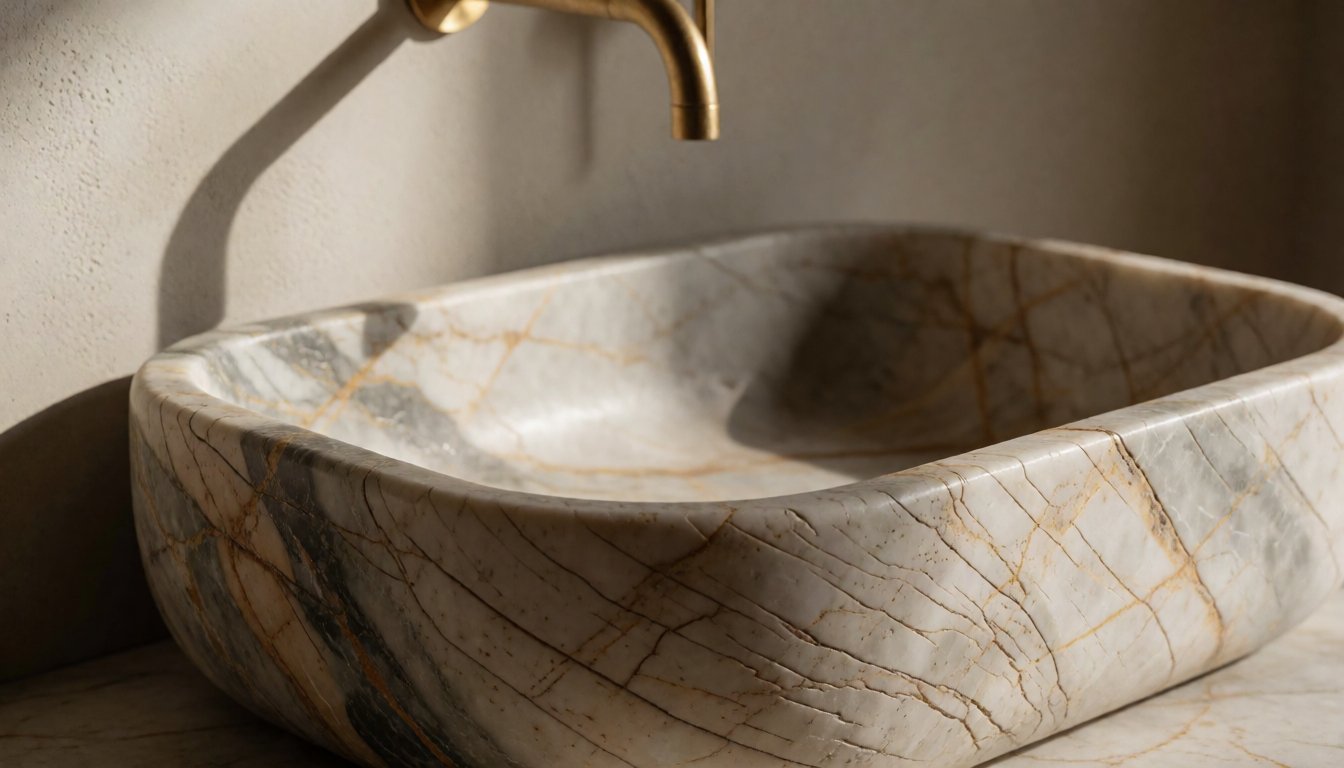
Beyond reclaimed marble, river stone basins are gaining specification momentum in 2026, particularly for wellness-focused projects (spas, retreat centers, biophilic residential schemes). Each basin is hand-selected for shape and character, then hand-finished by artisans. No two are identical. For wholesalers, the appeal is differentiation: a product that cannot be price-compared against mass-produced ceramic alternatives.
Key Considerations for Wholesalers and Installers
| Factor | Reclaimed Marble | River Stone | Virgin Marble |
|---|---|---|---|
| Carbon footprint | ~35–40% lower | Low (minimal processing) | Baseline |
| Lead time | 2–4 weeks (offcut availability dependent) | 3–6 weeks (hand-finishing) | 1–2 weeks |
| Price point (wholesale) | 10–20% premium | 20–35% premium | Baseline |
| Uniqueness | High (offcut-dependent) | Very high (hand-selected) | Low–Medium |
Frequently Asked Questions
Do reclaimed marble sinks stain more easily than new ones?
No. Stain resistance is determined by the sealant, not whether the stone is reclaimed. A properly sealed reclaimed sink performs identically to a new one.
Can reclaimed marble be used in commercial projects?
Yes. The same ASTM standards for structural integrity apply regardless of whether the stone is reclaimed. Specify 20mm minimum thickness for high-traffic commercial installations.
Where can I source reclaimed marble sinks for trade pricing?
Glady Stone supplies reclaimed marble basins and river stone sinks directly from affiliated quarries and fabrication partners. Request a trade quote here.
Glady Stone: Premium Natural Stone Basins for the Trade
Glady Stone sources reclaimed marble sinks, river stone basins, and custom natural stone vanity tops directly from affiliated quarries. Our B2B pricing structure supports wholesalers, architects, and designers across the US and Europe, with reliable lead times and slab-matching services for large projects.
Explore our natural stone basin collection and request a trade quote at gladystone.com.