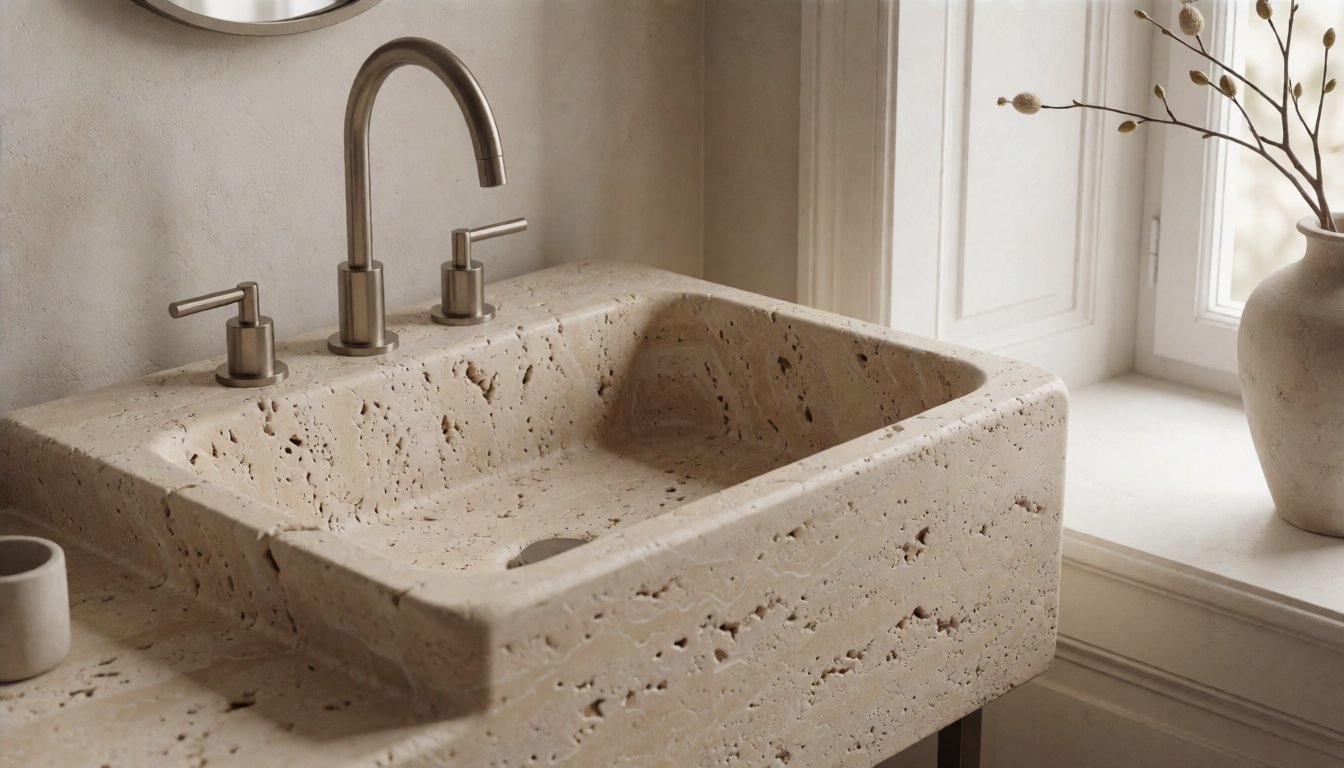
Many buyers import stone assuming that polishing solves all surface durability issues. This is a dangerous misconception for natural limestone like travertine. Polishing adds gloss and depth, but it does not change the fundamental porosity of the rock. Without proper travertine maintenance, raw stone will stain within weeks of installation. As an importer looking to stock sinks, bathtubs, or tabletops, you must understand that raw travertine care requires a different supply chain strategy than polished varieties. The cost of customer complaints and returns far outweighs the savings of skipping a sealing step.
Porosity is the Real Enemy
The primary difference between raw and polished travertine lies in how water interacts with the surface. Raw stone features natural pits and voids that are left open or lightly filled. Even after a standard honing process, these microscopic channels remain active. When you introduce a spill—whether it’s red wine, coffee, or harsh cleaning chemicals—the liquid penetrates deep into the matrix almost instantly.
Polished travertine fills some of these pores with wax or resin during finishing, creating a barrier. However, that barrier is not permanent. Over time, foot traffic and daily use wear down the polish layer. Once the polish degrades, the stone underneath remains vulnerable. If you sell raw slabs or finished pieces without advising on travertine sealing, your clients will see dark spots appearing under their kitchen sink in less than a month.
From a manufacturing perspective, Gladystone produces both polished and honed surfaces to meet different design needs. But for the importer, the critical distinction is not just aesthetics; it is about managing client expectations regarding raw travertine care. You cannot simply sell a “cheap” raw version without explaining that it requires specific handling. A polished slab might cost $20 more per square foot, but it reduces your liability by half because the stone resists staining for 6–12 months longer than raw versions.
The Critical Role of Sealing Products
No amount of polishing replaces a high-quality penetrating sealer. For natural stone importers, sourcing compatible sealing products is just as important as shipping the stone itself. Most standard household cleaners act as acids that etch limestone. If a customer uses vinegar or lemon juice on raw travertine, they leave permanent white marks and dull patches.
You need to ensure your suppliers provide neutral pH cleaning agents specifically designed for calcium carbonate stones. Typical lead times for restocking sealing kits are 3–5 days depending on the supplier’s location relative to US ports. Do not rely on generic advice; ask your stone vendor for their recommended sealer compatibility list. Some sealers dry too fast and block proper penetration, while others take weeks to cure fully.
For a standard vanity top measuring roughly 60×30 cm, a single application of a high-quality impregnating sealer costs roughly $15–$25 USD depending on the brand. This small expense prevents a customer from having to replace a $400 table entirely after one spill. When negotiating with manufacturers like Gladystone, clarify if sealing kits are included in your bulk order or sold separately. Some factories include a basic spray bottle in every carton of raw stone, but these are often insufficient for commercial applications.
Structural Integrity and Filling Void
Raw travertine often comes with voids that need filling. In polished pieces, manufacturers typically fill these pits with epoxy resins to create a uniform look. While effective for aesthetics, filled voids can sometimes trap moisture if the resin quality is poor. High-density epoxy ensures water cannot seep into the stone’s core. For raw travertine intended as a rustic or natural style, buyers expect visible holes. However, this demands rigorous travertine maintenance protocols from the end-user.
If you are importing sink basins, note that undermount sinks usually weigh between 30–50 kg depending on thickness (1.8 to 2.5 cm). Heavy stone sinks installed in poorly ventilated bathrooms can trap humidity against the stone if not sealed properly. Moisture trapped inside voids can lead to internal cracking over years of freeze-thaw cycles or thermal shock. Always inspect incoming raw slabs for structural cracks before sealing them. A minor hairline crack that is invisible at first glance can expand when the stone gets wet and heavy.
Ask your supplier about their quality control processes for detecting hidden fractures. Rejection rates for raw stone should be under 5% if the factory sorts carefully by density. If you receive a batch with high rejection rates, calculate the total loss including freight costs to return damaged goods. Shipping a full container of defective raw travertine can cost upwards of $10,000 USD in wasted inventory and demurrage fees at the port.
Managing Customer Expectations for Retailers
Selling raw or low-polish stone requires a shift in how you market your products to US/EU dropshippers and interior designers. You are selling an aesthetic, but you are also selling responsibility. If a customer buys a raw travertine dining table priced at $300 USD because of its rustic appeal, they must agree to seal it within 48 hours of installation.
Provide clear care guides in the box or on your website. Explain that water rings appear on unsealed stone quickly. Teach customers that oil-based stains require immediate blotting with a microfiber cloth. If you skip this education, negative reviews will destroy your reputation faster than low prices ever help.
For wholesalers, consider bundling raw travertine with starter kits containing neutral pH soap and a sealer bottle. This increases the average order value by roughly 10–15 USD per unit but significantly boosts customer retention. It shows you care about the longevity of their product. When discussing MOQs (Minimum Order Quantities) with factories, ensure they can supply consistent batches so you don’t have to explain to customers why one batch stains differently than another. Consistency in density and porosity is key to reliable raw travertine care.
Final Thoughts on Sourcing Quality Stone
In the natural stone business, quality is defined by how the material behaves after leaving the factory. Polished stone hides flaws temporarily; raw stone reveals them immediately. As an importer, your job is to filter out suppliers who promise “stain-free” results without proper sealing protocols. Realistically, no stone is stain-proof without maintenance.
Gladystone manufactures a wide range of sinks, vanities, and tabletops with varying levels of finish. When selecting raw travertine for your inventory, prioritize factories that offer transparent guidance on sealing and cleaning. Ask about their specific filling materials for voids and the curing times for those resins. Understand that travertine sealing is not an optional extra; it is a mandatory step for any calcium carbonate stone intended for high-traffic areas.
By educating your buyers and sourcing responsibly, you protect your profit margins and build trust. The initial cost of education and sealing kits pays for itself in reduced returns and fewer warranty claims. Focus on the long-term performance of the product rather than just the upfront price per square foot. That is how successful stone importers operate in a competitive market.