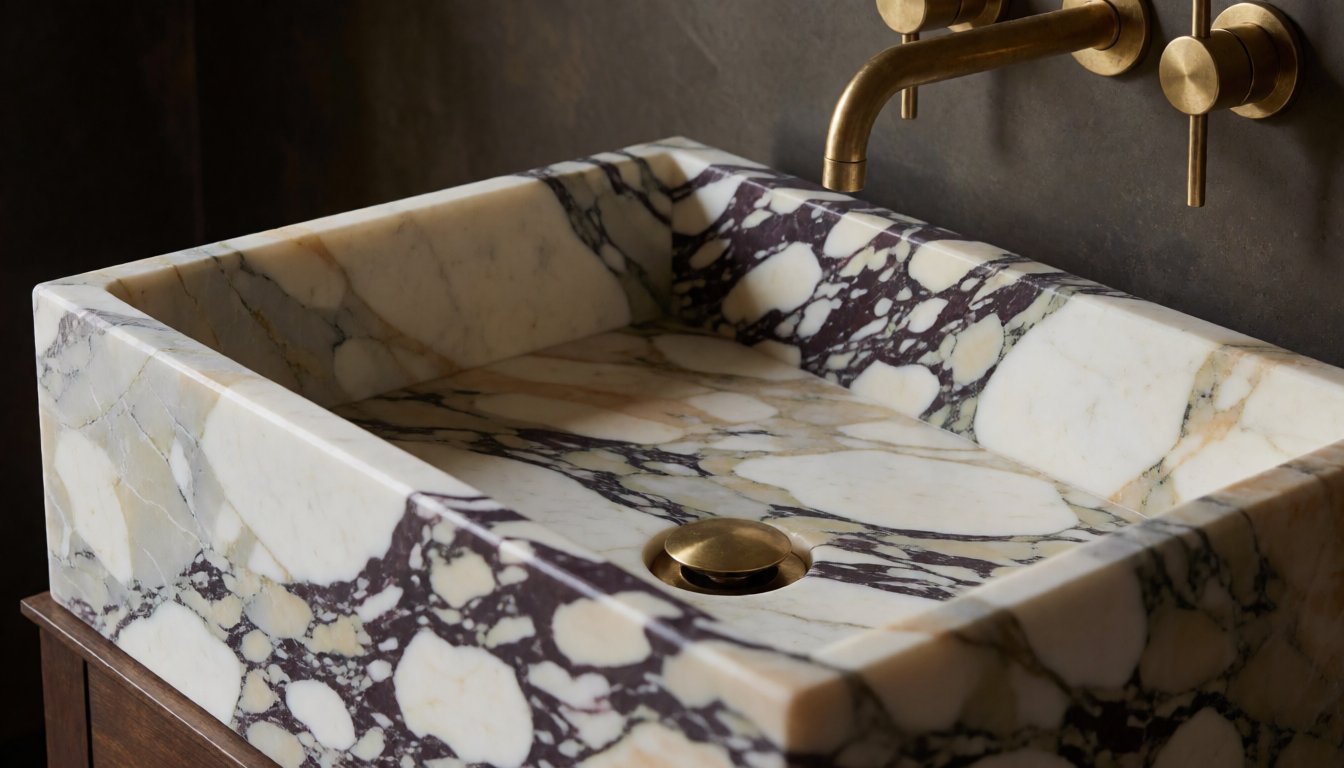
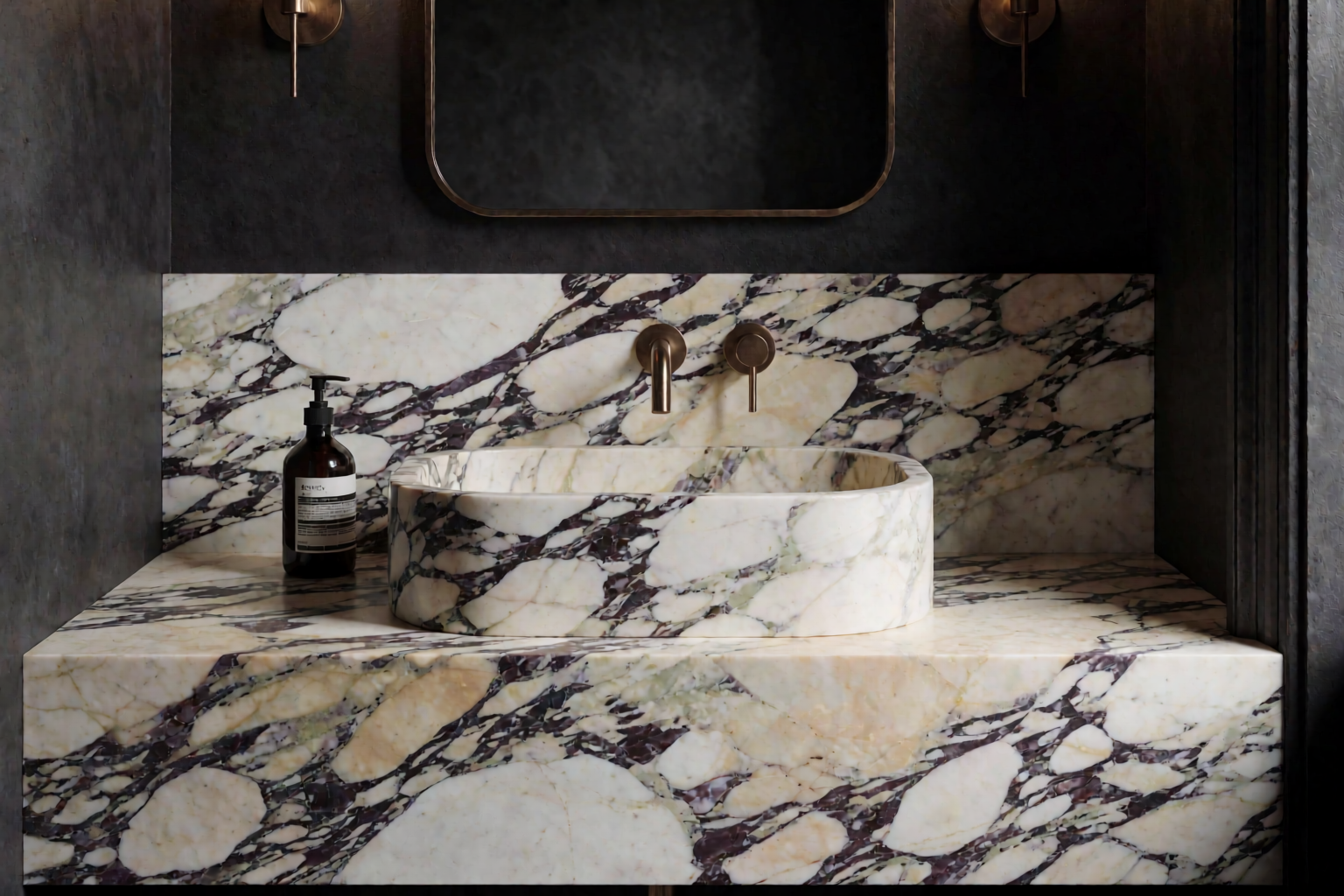
Calacatta Viola is a dramatic Italian marble defined by thick purple and grey veining on a creamy white base. In 2026, architects and wholesalers rank it the most-specified stone for bespoke basins because no two slabs share identical veining, making every carved sink a permanent one-of-a-kind fixture.
What Is Calacatta Viola Marble?
Calacatta Viola is quarried in the Apuan Alps of Tuscany and prized for violet-grey ribbons that sweep across an ivory ground. Unlike quiet Carrara, Viola is a statement stone: designers choose it precisely because it refuses to disappear into the background. For stone wholesalers, its rarity is a selling point, not a drawback.
Why Are Bold-Veined Sinks Trending in 2026?
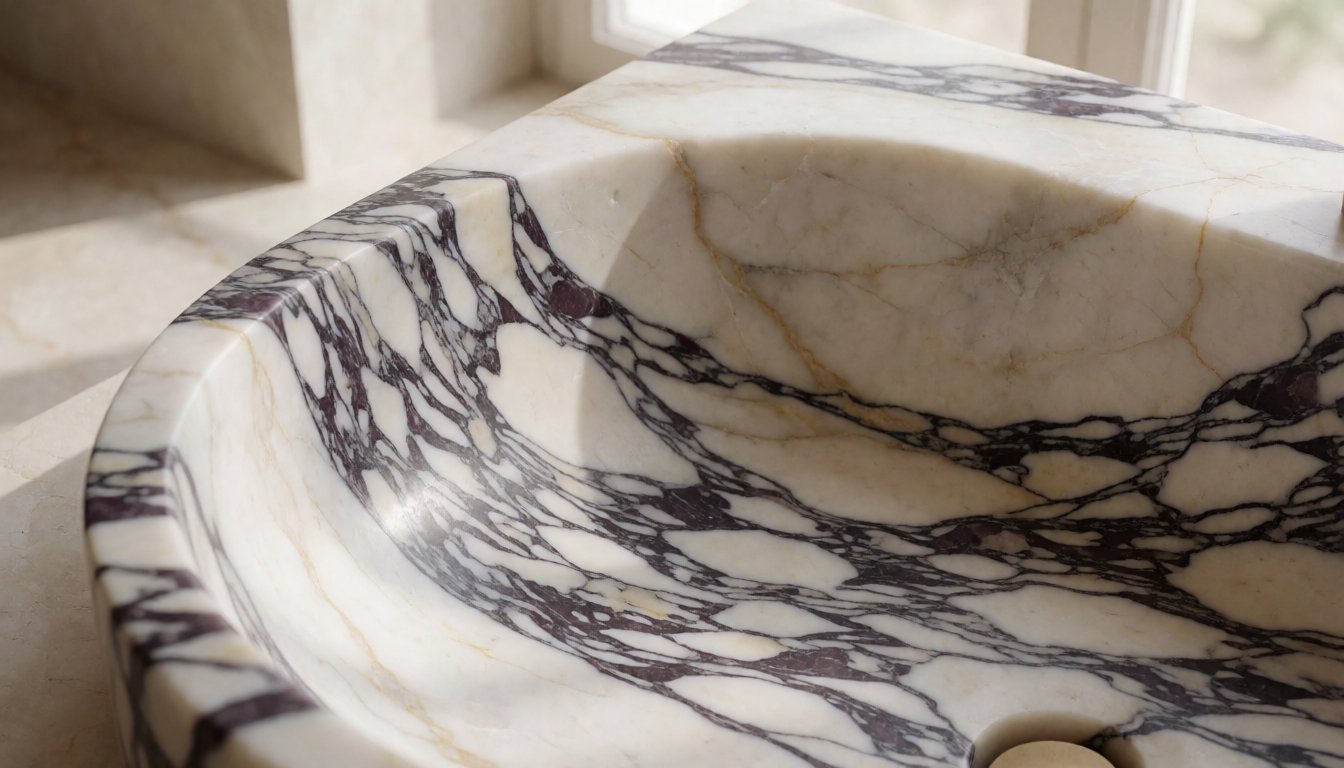
- Rarity as value: no two Viola slabs share identical veining, so a carved basin is permanently unique.
- Warm metal pairings: unlacquered brass and aged bronze draw out the stone’s hidden amber undertones.
- Moody bathrooms: dark, atmospheric schemes let Viola read entirely differently than in bright white rooms.
How to Specify a Calacatta Viola Basin for a Project
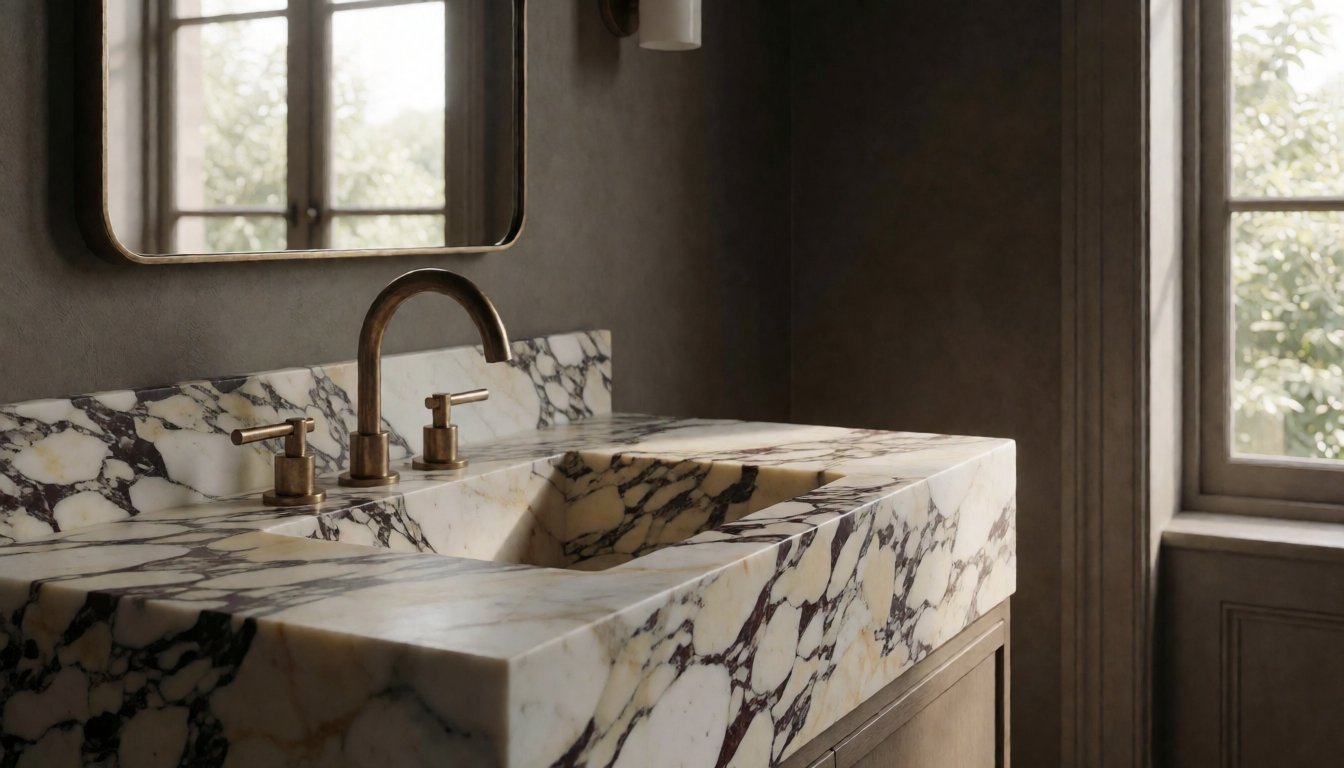
Calacatta Viola forms in the Apuan Alps of Tuscany, where iron and manganese deposits create the stone’s signature violet-grey ribbons against an ivory ground. According to Italian quarry data, yield of book-grade Viola suitable for a single-block vessel sink is below 15% of each block, which is precisely why architects treat it as a commission rather than a commodity. In 2026 specifications, designers pair the marble with unlacquered brass or aged bronze hardware so warm metal tones draw out the amber undertones hidden in the veining. A hand-carved Viola basin cut from one monolithic block resists the seams and hollow sounds of assembled units, and its weight — often 40 to 70 kilograms — signals the permanence luxury buyers now demand over fast, disposable finishes. For wholesalers, the practical upside is consolidation: a single Viola basin can anchor an entire vanity specification, reducing the SKU count a showroom must stock while lifting average order value by an estimated 30 to 45% versus a factory-produced ceramic basin.
| Stone Variety | Veining Character | Best Finish | Seal Cadence |
|---|---|---|---|
| Calacatta Viola | Bold purple-grey ribbons | Honed or polished | Every 6–12 months |
| Arabescato | Soft grey, muted movement | Polished | Every 9–12 months |
| Nero Marquina | Black with white lightning veins | Polished | Every 6–12 months |
| Travertine | Beige, porous, earthy | Leathered | Every 6 months |
Frequently Asked Questions
Why is Calacatta Viola more expensive than Carrara?
Viola’s dramatic figure and lower quarry yield make book-grade blocks scarce; you pay for uniqueness, not just material.
Does a bold-veined marble sink stain easily?
Like all calcite stone it etches from acid, but a penetrating sealer applied every 6–12 months keeps daily stains at bay.
Can Calacatta Viola be used in a dark bathroom?
Yes. The purple veining reads richer against charcoal walls and warm candlelight than in a stark white room.
How heavy is a carved marble basin?
A single-block Viola sink typically weighs 40–70 kg, so the vanity must be structurally supported.
Glady Stone: Bespoke Marble Basin Collection
Glady Stone supplies hand-carved natural stone basins in Calacatta Viola, Arabescato and travertine for architects and wholesalers specifying 2026 luxury bathrooms.
Explore the Glady Stone natural stone basin collection for single-block, made-to-order marble sinks.